
How to Determine Fluid Velocity in a Heat Exchanger
Learn engineering principles to determine the optimal fluid velocity for industrial heat exchangers. Improve heat transfer, minimize fouling, and maintain energy efficiency.
Fluid velocity is critical for heat exchanger performance, influencing heat transfer, pressure drop, fouling resistance, and equipment lifespan. Determining the proper velocity balances efficiency and energy consumption.
Contact Our Team on WhatsApp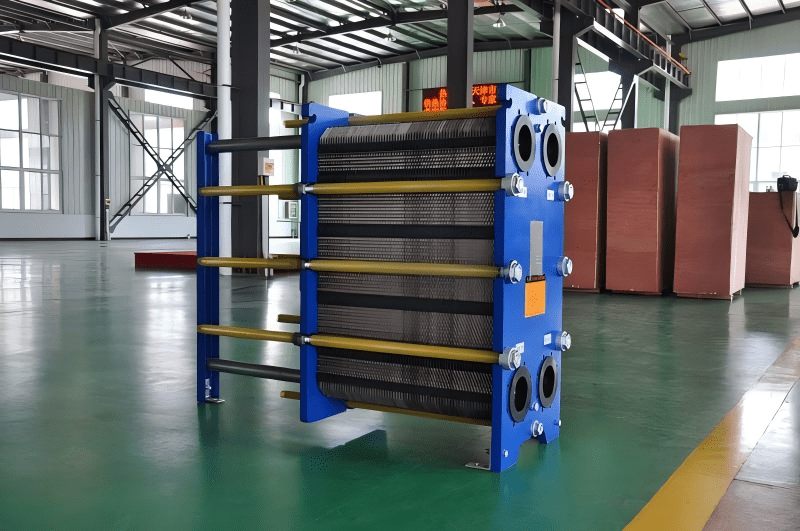
Effect of Fluid Velocity on Heat Transfer and Pressure Drop
Higher fluid velocity increases turbulence, thins thermal boundary layers, and improves heat transfer. In plate heat exchangers, 0.1–1.0 m/s can generate strong turbulence efficiently. However, excessive velocity increases pressure drop and pumping costs, so optimization is essential.
Minimum Velocity for Turbulent Flow
Ensuring turbulent flow (Re ≥ 4000) is crucial. Laminar flow reduces efficiency and increases fouling risk. Plate corrugation enhances turbulence even at low velocities, making them more thermally efficient than traditional shell and tube designs.
Maximum Velocity Limits
Velocity is limited by pressure drop and erosion corrosion. Excessive velocity can cause high pressure drops, increased pumping power, and surface erosion. Typical safe limits:
- Carbon steel tubes: ≤ 2 m/s
- Stainless steel or titanium tubes: 3–4 m/s
Influence of Fluid Properties
- Fouling fluids: Velocity > 1 m/s reduces scaling.
- Particle-containing fluids: Must suspend particles without causing erosion.
- High-viscosity fluids: Higher velocity promotes turbulence.
Typical Velocity Ranges by Heat Exchanger Type
- Shell & Tube: Tube side 1–3 m/s; shell side 0.5–1.5 m/s.
- Plate Heat Exchangers: 0.3–1.0 m/s due to narrow channels and strong turbulence.
Conclusion
Determining optimal velocity balances heat transfer efficiency, pressure drop, fouling prevention, and equipment durability. By defining a stable operating range, Tershion ensures reliable, high-efficiency, long-service heat exchanger performance.
Frequently Asked Questions (FAQ)
1. What is the typical fluid velocity in a heat exchanger?
Typical velocities depend on the heat exchanger type. Plate heat exchangers usually operate at 0.3–1.0 m/s, while shell and tube heat exchangers operate at 1–3 m/s on the tube side.
2. Why is fluid velocity important in heat exchangers?
Fluid velocity affects heat transfer efficiency, pressure drop, fouling formation, and equipment lifespan. Proper velocity improves thermal performance while minimizing energy consumption.
3. How does velocity affect fouling in heat exchangers?
Higher fluid velocity reduces fouling because stronger turbulence prevents particles and scale from depositing on heat transfer surfaces.