
Why Silicon Carbide Is Ideal for High-Temperature Applications
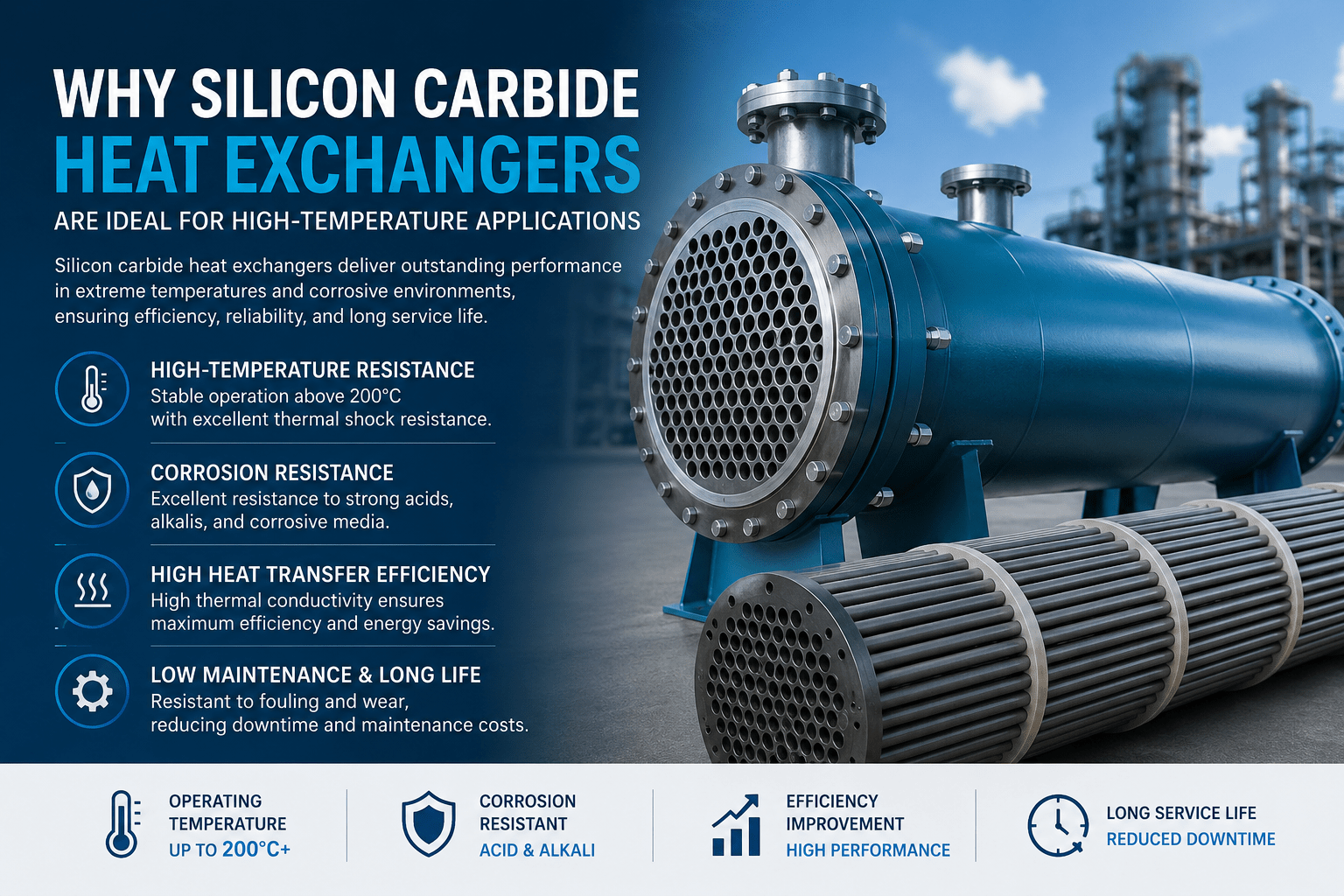
In high-temperature and corrosive environments, traditional materials often fail. Discover why Silicon Carbide heat exchangers deliver superior performance, reliability, and long-term value.
Key Benefits at a Glance
✔ Handles temperatures above 200°C
✔ Excellent resistance to strong acids
✔ High heat transfer efficiency
✔ Reduced fouling and scaling
✔ Long service life with low maintenance
In demanding industrial systems, material selection directly determines heat exchanger reliability. Silicon Carbide (SiC) has become a preferred solution in applications involving high temperatures, aggressive media, and continuous operation.
Designed for Extreme Temperatures
Silicon Carbide maintains structural stability under continuous high-temperature operation.
✔ Stable above 200°C
✔ Low thermal expansion
✔ Resistant to thermal fatigue
This makes it ideal for acid concentration, chemical reactions, and heat recovery systems.
Built for Corrosive Environments
Unlike metal alloys, Silicon Carbide is not subject to electrochemical corrosion.
✔ Resistant to sulfuric acid and hydrochloric acid
✔ No pitting or stress corrosion cracking
✔ Stable in oxidizing environments
This significantly extends equipment lifespan and reduces maintenance frequency.
Engineered for Heat Transfer Efficiency
Silicon Carbide offers high thermal conductivity and stable long-term performance.
✔ Efficient heat transfer
✔ Lower energy consumption
✔ Consistent process performance
Reduced Fouling and Wear
In real-world conditions, fouling and abrasion are major challenges.
✔ Smooth surface reduces scaling
✔ High hardness resists particle erosion
✔ Suitable for wastewater and slurry systems
Lower Total Cost of Ownership
Although initial costs may be higher, Silicon Carbide delivers long-term value through:
✔ Fewer shutdowns
✔ Reduced maintenance
✔ Longer service life
Conclusion
For high-temperature and corrosive applications, Silicon Carbide offers a powerful combination of durability, efficiency, and reliability.
It is an ideal material choice for modern industrial heat exchangers where performance and longevity are critical.
Contact Our Engineers